Purlisse Beauty Blue Lotus Seed Mud Mask Exfoliant
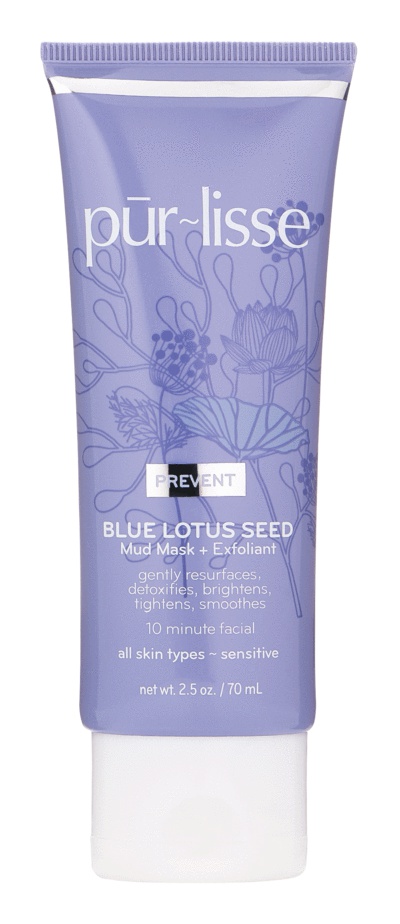
Blue Lotus Seed Mud Mask + Exfoliant
Detoxifying skin with our BLUE LOTUS Seed Mud Mask + Exfoliant will instantly improve skin's texture in minutes with a power blend of BLUE LOTUS, BAMBOO, GINGER, MUSHROOM EXTRACT and WHITE TEA.
Uploaded by: katiely1027 on
Ingredients overview
Water, Kaolin, Bentonite, Glyceryl Stearate SE, Cetearyl Alcohol, Microcrystalline Cellulose, Glycerin, Nymphaea Coerulea (Blue Lotus) Extract, Mushroom Extract, Bambusa Arundinacea Stem Powder (Bamboo), Nelumbo Nucifera Seed Powder (Lotus), Oryza Sativa (Rice) Bran Water, Zingiber Officinale (Ginger) Water, Camellia Sinensis (White Tea) Extract, Pumice, Phenoxyethanol, Caprylhydroxamic Acid, Caprylyl Glycol
Highlights
Key Ingredients
Other Ingredients
Skim through
| Ingredient name | what-it-does | irr., com. | ID-Rating |
|---|---|---|---|
| Water | solvent | ||
| Kaolin | colorant, abrasive/scrub | 0, 0 | goodie |
| Bentonite | viscosity controlling | 0, 0 | goodie |
| Glyceryl Stearate SE | emulsifying | 2, 3 | |
| Cetearyl Alcohol | emollient, viscosity controlling, emulsifying, surfactant/cleansing | 1, 2 | |
| Microcrystalline Cellulose | viscosity controlling | ||
| Glycerin | skin-identical ingredient, moisturizer/humectant | 0, 0 | superstar |
| Nymphaea Coerulea (Blue Lotus) Extract | |||
| Mushroom Extract | |||
| Bambusa Arundinacea Stem Powder (Bamboo) | abrasive/scrub | ||
| Nelumbo Nucifera Seed Powder (Lotus) | |||
| Oryza Sativa (Rice) Bran Water | |||
| Zingiber Officinale (Ginger) Water | |||
| Camellia Sinensis (White Tea) Extract | antioxidant, soothing | goodie | |
| Pumice | abrasive/scrub, viscosity controlling | ||
| Phenoxyethanol | preservative | ||
| Caprylhydroxamic Acid | chelating | ||
| Caprylyl Glycol | moisturizer/humectant, emollient |
Purlisse Blue Lotus Seed Mud Mask + Exfoliant
Ingredients explainedAlso-called: Aqua | What-it-does: solvent
Good old water, aka H2O. The most common skincare ingredient of all. You can usually find it right in the very first spot of the ingredient list, meaning it's the biggest thing out of all the stuff that makes up the product.
It's mainly a solvent for ingredients that do not like to dissolve in oils but rather in water.
Once inside the skin, it hydrates, but not from the outside - putting pure water on the skin (hello long baths!) is drying.
One more thing: the water used in cosmetics is purified and deionized (it means that almost all of the mineral ions inside it is removed). Like this, the products can stay more stable over time.
Kaolin is a type of clay or to be precise, a naturally occurring hydrous aluminum silicate. When you hear clay, you probably think of a muddy greenish-black mess, but that one is bentonite, and this one is a fine, white powder. It is so white that it's also often used, in small amounts, as a helper ingredient to give opacity and whiteness to the cosmetic formulas.
As a clay, it's absorbent and can suck up excess sebum and gunk from your skin, but less so than the more aggressive bentonite. As it's less absorbent, it's also less drying and gentler on the skin, so it's ideal for dry and sensitive skin types.
When it comes to oil-absorbing clay masks, bentonite will probably be one of the first ingredients on the INCI list. Technically bentonite clay is mostly montmorillonite + something else, and thanks to the something else bit,bentonite comes in different types and colors.
The color depends on the mineral content of the clay: white bentonite is rich in boron and fluoride, yellow is rich in manganese and zinc, green is rich in copper, zinc, and manganese and the pink clay is rich in boron.
No matter the color, bentonite is excellent at absorbing things: it can suck up the sebum and gunk from the skin and make it instantly smooth and matte. Not only that, but bentonite has a negative ionic charge and thus can attract things with a positive charge. Things with a positive charge include bad bacteria and toxins and bentonite clay masks can help to clear those out of the skin and pores (btw, bentonite is edible and has the same detoxifying effect internally).
Thanks to bentonite's effect against bad bacteria and pathogens, there is also some research showing that bentonite can help tocalm skin infections, soothe skin allergies and might work for skin conditions likepsoriasis and eczema.
On the other hand, the downside of bentonite being such a good absorbent is that it can suck up more than the excess sebum and used too often, it can easily dry out the skin. So use it for good measure, and never forget to moisturize afterwards.
What-it-does: emulsifying | Irritancy: 2 | Comedogenicity: 3
An oily kind of ingredient that can magically blend with water all by itself. This is called self-emulsifying and SE in its name stands for that.
The difference between "normal" Glyceryl Stearate and this guy is that the SE grade contains a small amount of water-loving soap molecules, such as sodium stearate. This increases Glyceryl Stearate's affinity for water and gives it stronger emulsifying abilities.
Other than that, it's a nice emollient that gives a smooth and soft appearance to the skin.
You can read some more at Glyceryl Stearate >>
An extremely common multitasker ingredient that gives your skin a nice soft feel (emollient) and gives body to creams and lotions. It also helps to stabilize oil-water mixes (emulsions), though it does not function as an emulsifier in itself. Its typical use level in most cream type formulas is 2-3%.
It's a so-called fatty alcohol, a mix of cetyl and stearyl alcohol, other two emollient fatty alcohols. Though chemically speaking, it is alcohol (as in, it has an -OH group in its molecule), its properties are totally different from the properties of low molecular weight or drying alcohols such as denat. alcohol. Fatty alcohols have a long oil-soluble (and thus emollient) tail part that makes them absolutely non-drying and non-irritating and are totally ok for the skin.
Cellulose is an important component of the cell walls of green plants and it's the most abundant natural polymer (big molecule from repeated subunits) on Earth. If the polymer structure is not too big (less than 200 repeated units), cellulose becomes microcrystalline cellulose.
In skin care, it comes as a fine or less fine white powder. The less fine (bigger particle size) version is used as a gentle scrubbing agent (a nice natural, biodegradable alternative to now banned plastic polyethylene) and the ultra fine version is used as a helper ingredient that gives a super-silky, soft touch, reduces tackiness or greasiness and can also be used as a mattifying agent.
Combined with Cellulose Gum, it also works as a nice gelling agent.
- A natural moisturizer that's also in our skin
- A super common, safe, effective and cheap molecule used for more than 50 years
- Not only a simple moisturizer but knows much more: keeps the skin lipids between our skin cells in a healthy (liquid crystal) state, protects against irritation, helps to restore barrier
- Effective from as low as 3% with even more benefits at higher concentrations up to 20-40% (around 10% is a good usability-effectiveness sweet spot)
- High-glycerin moisturizers are awesome for treating severely dry skin
Read all the geeky details about Glycerin here >>
Also-called: Blue Lotus Extract;Nymphaea Coerulea Flower Extract
 We don't have description for this ingredient yet.
Also-called: Reishi Mushroom Extract;Ganoderma Lucidum Extract
We don't have description for this ingredient yet.
We don't have description for this ingredient yet.
We don't have description for this ingredient yet.
We don't have description for this ingredient yet.
We don't have description for this ingredient yet.
Also-called: Green Tea;Camellia Sinensis Leaf Extract | What-it-does: antioxidant, soothing
- Green tea is one of the most researched natural ingredients
- The active parts are called polyphenols, or more precisely catechins (EGCG being the most abundant and most active catechin)
- There can be huge quality differences between green tea extracts. The good ones contain 50-90% catechins (and often make the product brown and give it a distinctive smell)
- Green tea is proven to be a great antioxidant, UV protectant, anti-inflammatory, anticarcinogenic and antimicrobial
- Because of these awesome properties green tea is a great choice for anti-aging and also for skin diseases including rosacea, acne and atopic dermatitis
Read all the geeky details about Camellia Sinensis Leaf Extract here >>
We don't have description for this ingredient yet.
It's pretty much the current IT-preservative. It's safe and gentle, but even more importantly, it's not a feared-by-everyone-mostly-without-scientific-reason paraben.
It's not something new: it was introduced around 1950 and today it can be used up to 1% worldwide. It can be found in nature - in green tea - but the version used in cosmetics is synthetic.
Other than having a good safety profile and being quite gentle to the skin it has some other advantages too. It can be used in many types of formulations as it has great thermal stability (can be heated up to 85°C) and works on a wide range of pH levels (ph 3-10).
It's often used together with ethylhexylglycerin as it nicely improves the preservative activity of phenoxyethanol.
A chelating agent that helps to preserve cosmetic products by neutralizing the metal ions (especially iron) in the formula (that usually get into there from water). Its special thing is that it also acts as abiostatic and fungistatic agent and remains active even at high pH.
It is often coupled with antimicrobial glycols (such as propanediol) to create a "preservative free preservative system" for cosmetic products.
It's a handy multi-tasking ingredient that gives the skin a nice, soft feel. At the same time, it also boosts the effectiveness of other preservatives, such as the nowadays super commonly used phenoxyethanol.
The blend of these two (caprylyl glycol + phenoxyethanol) is called Optiphen, which not only helps to keep your cosmetics free from nasty things for a long time but also gives a good feel to the finished product. It's a popular duo.
You may also want to take a look at...
Normal (well kind of - it's purified and deionized) water. Usually the main solvent in cosmetic products. [more] A type of clay that's a fine, white powder and is used for its oil-absorbing and opacifying properties. It's less absorbent and less drying than bentonite clay. [more] A highly absorbent clay that comes in different colors depending on its mineral content. It's excellent at absorbing things including sebum and gunk in the pores and it also has some skin soothing and "detoxifying" effect. [more] An oily ingredient that can magically blend with water all by itself (called Self Emulsifying). Other than that it's a nice emollient that gives a smooth and soft appearance to the skin. [more] A super common multitasker ingredient that gives your skin a nice soft feel (emollient) and gives body to creams. [more] A smaller version of the natural, cell-wall building polymer cellulose. Mostly used as a mattifier or a helper ingredient that improves the skin feel of the formula. [more] A real oldie but a goodie. Great natural moisturizer and skin-identical ingredient that plays an important role in skin hydration and general skin health. [more] Pretty much the current IT-preservative. It's safe and gentle, and can be used up to 1% worldwide. [more] A chelating agent that helps to preserve cosmetic products by neutralizing the metal ions (especially iron) in the formula (that usually get into there from water). [more] A handy multi-tasking ingredient that gives the skin a nice, soft feel and also boosts the effectiveness of other preservatives. [more]
Source: https://incidecoder.com/products/purlisse-blue-lotus-seed-mud-mask-exfoliant
0 Response to "Purlisse Beauty Blue Lotus Seed Mud Mask Exfoliant"
Post a Comment